From Detection to Defense: Building a Measurable Secret Risk Reduction Strategy
Secret detection has become a standard practice for uncovering exposed credentials across code repositories, collaboration tools, and cloud environments. Yet discovery alone does not automatically reduce risk. Once a secret is found, teams must assess its relevance, verify whether it is still active, determine if it is already managed in a secure system, and decide on the right remediation path. This process often involves multiple teams and workflows, from security to development to operations. Vault Radar is designed to transform raw detection into a structured, measurable risk reduction process. The following questions explore how correlation, workflow integration, and accountability turn secret scanning into a more mature, effective practice.
Why is secret detection alone insufficient for reducing risk?
Secret detection provides visibility into exposures, but without additional context, each finding lacks actionable meaning. Knowing that a credential is exposed does not tell you whether it is still active, who owns it, or if it is already managed in a centralized secrets vault. Without this context, teams may treat every finding with the same urgency, leading to wasted effort on false positives or non-critical exposures. Furthermore, detection does not trigger remediation unless there is a clear workflow for notification, ownership assignment, and follow-through. In practice, this means that detected secrets often remain exposed for long periods while teams try to determine next steps. The real risk reduction comes not from finding secrets but from understanding their state and quickly moving them under control. Vault Radar addresses this by providing correlation with secret management systems like Vault and AWS Secrets Manager, giving teams the context they need to prioritize and act effectively.
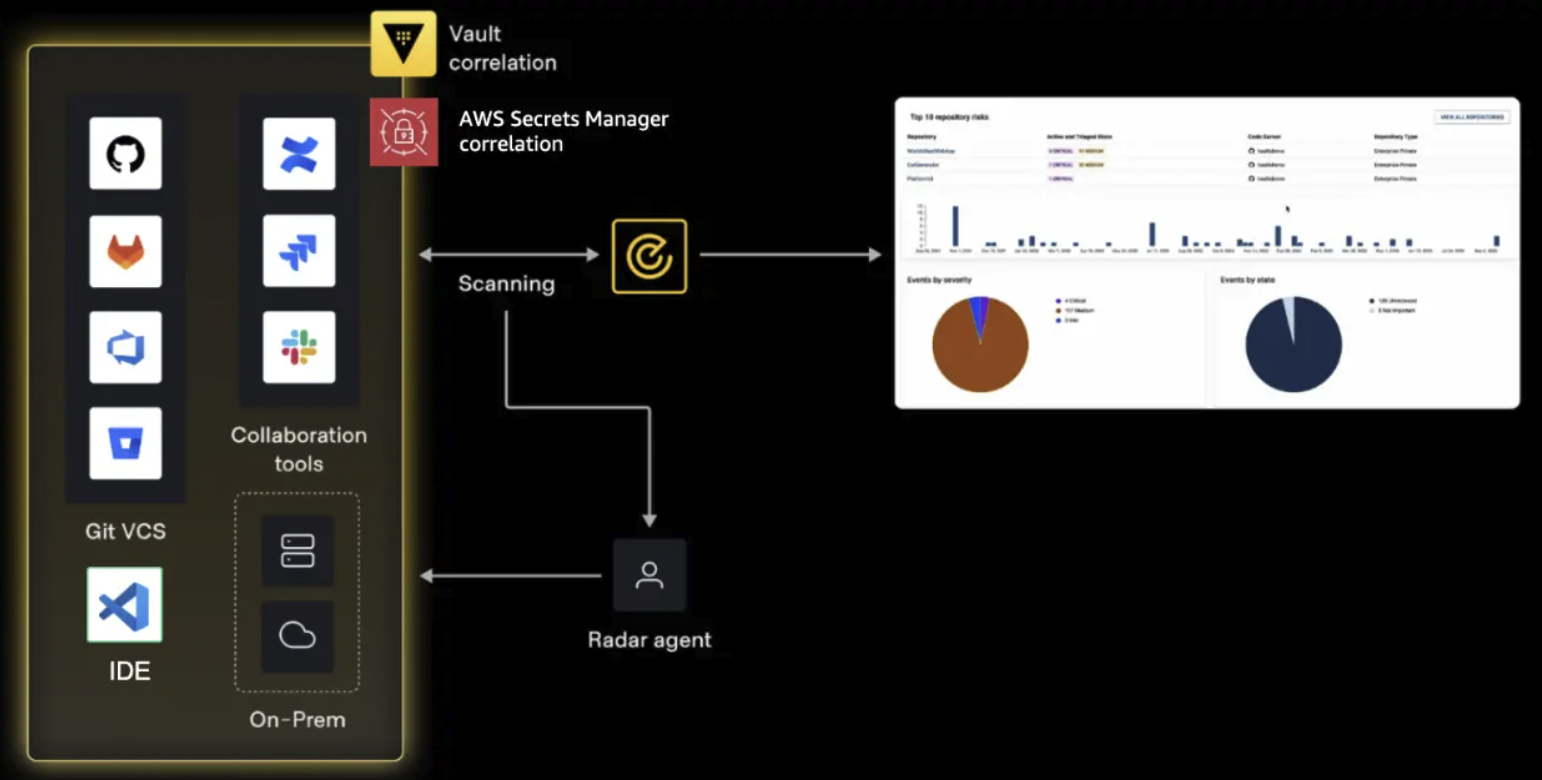
How does secret correlation with Vault and AWS Secrets Manager improve response?
Correlation allows Vault Radar to match a detected secret against those already stored in approved management systems. This distinction is critical because it separates findings into two categories: secrets that are already managed but exposed, and secrets that appear to be created or stored outside sanctioned workflows. For managed secrets, teams can quickly see ownership details, rotation policies, and lifecycle status, enabling a targeted response such as rotating the credential or updating its usage. For unmanaged secrets, correlation highlights governance gaps—indicating that credentials are being created or copied without going through approved vaults. This visibility helps security and platform teams identify where centralized controls are not being followed. Over time, correlation data reveals patterns: areas where secret management is working well and where additional training or automation is needed. The outcome is a prioritized, informed approach to remediation that reduces noise and accelerates risk reduction.
What role do webhooks play in secret remediation workflows?
Webhooks extend detection beyond a single tool by pushing notifications into the workflows teams already use. When Vault Radar identifies an exposed secret, a webhook can trigger actions in collaboration platforms, ticketing systems, or CI/CD pipelines. For example, a webhook might create a ticket in Jira, send a Slack message to the repository owner, or trigger a pipeline to rotate a credential automatically. This integration ensures that findings reach the right people quickly, without requiring manual checks of a separate dashboard. It also allows remediation steps to be embedded in existing processes, reducing friction and accelerating response times. Different teams—security, development, operations—can each receive tailored notifications based on their role. Over time, webhook data can also feed metrics dashboards to track how quickly exposures are addressed. By bringing detection directly into operational workflows, webhooks help turn passive scanning into active, continuous risk reduction.
How can organizations measure progress in secret risk reduction?
Measurable progress requires tracking metrics that go beyond the number of secrets detected. Key indicators include the time between detection and remediation, the percentage of findings correlated with managed secrets, and the rate of repeat exposures from the same teams or repositories. Vault Radar provides dashboards and reporting that aggregate these metrics, enabling security teams to see trends over time. For instance, a decreasing time-to-remediation indicates that workflow integration and ownership assignment are improving. An increasing correlation rate shows that more teams are using centralized vaults, reflecting stronger governance. Organizations can also track the number of unmanaged secrets found per month as a measure of policy compliance. By focusing on these outcomes rather than raw detection counts, teams can demonstrate tangible risk reduction to leadership and identify areas where additional automation or training is needed. The goal is to move from a reactive posture to a proactive one, where secret management becomes part of the normal development lifecycle.
What are the common challenges in secret remediation across teams?
Secret remediation often involves multiple stakeholders: security teams that detect exposures, developers who own the code, platform teams that manage infrastructure, and operations teams responsible for rotation and monitoring. A common challenge is ambiguity in ownership—who should take action on a given finding? Without clear context, findings may bounce between teams or languish in queues. Another challenge is tool fragmentation: each team may use different systems for tracking work, communicating, and deploying changes. Vault Radar addresses these issues by correlating secrets with ownership metadata from Vault and by using webhooks to route notifications to the right workflow. Additionally, different teams may have different priorities: security wants quick remediation, while developers may need to balance feature work. To overcome this, organizations should define clear service-level agreements (SLAs) for secret response and embed remediation steps into development pipelines. Automation, such as automatic credential rotation upon detection, can further reduce friction and ensure consistent action.
How does Vault Radar help build a mature remediation process?
Vault Radar supports secret maturity through three key capabilities: correlation, workflow integration, and measurable reporting. Correlation provides immediate context about whether a secret is managed or unmanaged, enabling teams to prioritize and take appropriate action. Workflow integration via webhooks ensures that findings reach the right owners within their existing tools, reducing delays and handoff errors. Measurable reporting tracks metrics like time-to-remediation and correlation rates, giving organizations visibility into how well their secret management practices are being followed. Over time, this data informs policy adjustments and automation improvements. For example, if unmanaged secrets are frequent in a particular repository, teams can add vault integration to the development process there. By shifting from isolated detection to a continuous cycle of detection, context, and remediation, Vault Radar helps organizations reduce risk in a quantifiable way. The result is not just fewer exposed secrets, but a stronger culture of security built into everyday workflows.
Why is it important to distinguish between managed and unmanaged secrets?
Not every exposed secret carries the same risk. A secret that is already stored in a vault like Vault or AWS Secrets Manager may have built-in controls: it can be rotated on demand, its usage can be audited, and ownership is documented. If such a secret is exposed, the response is often straightforward—rotate it and update any cached copies. In contrast, an unmanaged secret may have no owner, no rotation policy, and no audit trail. Its exposure signals a governance gap where credentials are being created or stored outside approved systems. Responding to unmanaged secrets requires more investigation: finding who created it, understanding its purpose, and ensuring it is moved into a vault. By distinguishing these two scenarios, Vault Radar allows teams to allocate resources efficiently. It also helps security leaders identify systemic issues—for example, if a particular team frequently has unmanaged secrets, that indicates a need for training or better tool integration. This distinction turns raw findings into strategic intelligence for improving secret management across the organization.