Capturing True Spectra: The Art and Science of Structural Color Photography
Conventional color photography relies on human trichromatic vision, capturing only three primary colors and tricking our eyes into seeing a full-color image. But some techniques, like the historic Lippmann plate, go far beyond by recording the actual spectrum of light—a true-spectrum photograph. Instead of using dyes or pigments, these plates create microscopic structures that reflect specific wavelengths, much like a butterfly's wing. This article dives into the fascinating world of structural color photography, exploring how these plates work, their unique properties, and why they never became mainstream.
What is true-spectrum photography and how does it differ from conventional color photography?
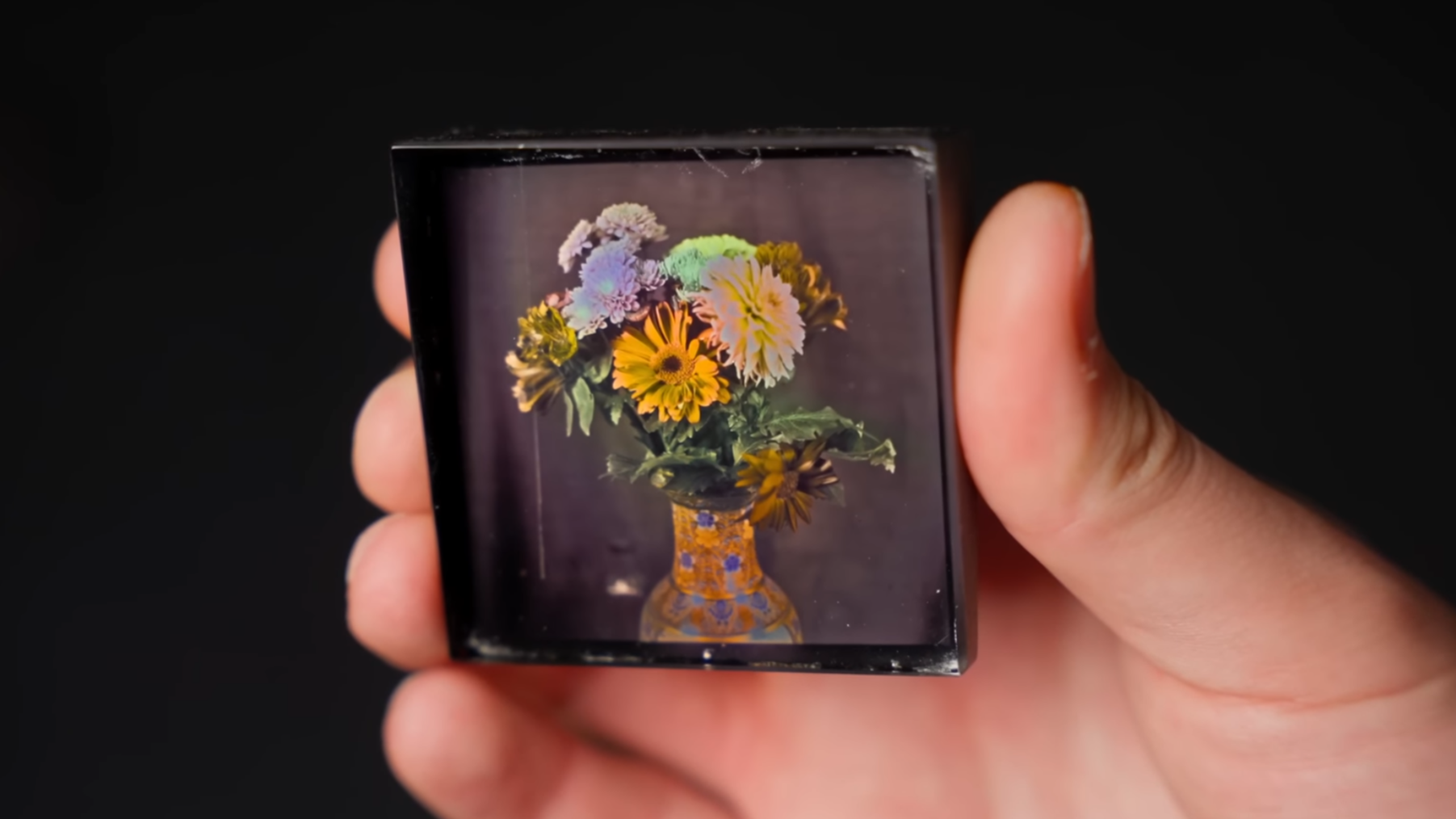
True-spectrum photography refers to methods that capture the full spectral profile of light in a scene, rather than just encoding three primary colors as our eyes perceive them. Conventional cameras use the trichromatic theory—mixing red, green, and blue to approximate all colors. This works because human vision has only three types of color-sensitive cones; a spectrometer, however, reveals gaps between the three colors in a photo and the continuous spectrum of the original scene. In contrast, a true-spectrum photo records every wavelength independently. The most famous historical example is the Lippmann plate, which stores the actual interference pattern of light. This means the photograph, when viewed, reflects back the exact same spectral composition as the scene, producing colors that are physically accurate, not just visually convincing.
How do Lippmann plates capture the full spectrum?
A Lippmann plate begins with a glass plate coated with a fine-grained photographic emulsion containing tiny silver halide crystals. The plate is placed in a camera with its back against a mirror—traditionally a pool of mercury. Light passes through the emulsion, reflects off the mirror, and creates a standing wave pattern within the emulsion. At the antinodes (points of maximum wave amplitude), the light energy is highest, causing the silver halide crystals to develop into reflective silver particles. The spacing between these silver layers depends directly on the wavelength of the incoming light. After development, the plate contains a vertical stack of these silver layers, each acting as a diffraction grating. When white light shines on the plate, each grating reflects only the original wavelength, reconstructing the exact spectrum of light that created it.
Why does a Lippmann plate reproduce the original spectrum rather than just three colors?
The key lies in the vertical arrangement of the silver layers within the emulsion. Unlike a conventional diffraction grating, which is a flat surface with parallel lines, Lippmann plates have a three-dimensional, layered structure. Each layer is spaced at a distance equal to half the wavelength of the light that formed it. Because these layers are stacked vertically, they function as a volume hologram. When illuminated with white light, they diffract only a narrow range of wavelengths—precisely the ones that created them—and they do so consistently across a range of viewing angles (though limited; see Q4). This means each tiny area of the plate acts as a selective mirror for a specific color. As a result, the photograph stores information for every wavelength present in the scene, not just three primaries. A spectrometer scanning the plate would find the spectral signature matches the original.
What were the main limitations that kept Lippmann plates from becoming popular?
Despite their incredible spectral accuracy, Lippmann plates had several practical drawbacks. First, the viewing angle is severely limited: you can only see the true colors when looking nearly straight-on at the plate. Tilt it slightly, and the colors vanish or shift—unlike modern dye-based photos that look good from almost any angle. Second, exposures were extremely long—often minutes or hours—because the emulsion had to be ultra-fine-grained to resolve the interference pattern, making it very slow. Third, the process was finicky: the mercury mirror had to be perfectly flat and clean, and the developed plates often produced washed-out colors if any step went wrong. Finally, Lippmann plates are unique, one-of-a-kind artifacts; you cannot make reprints or copies because the color is physically embedded in the structure. These factors confined them to the laboratory, while simpler, more reproducible methods like autochrome and later film and digital photography won the market.
How are Lippmann plates related to holograms?
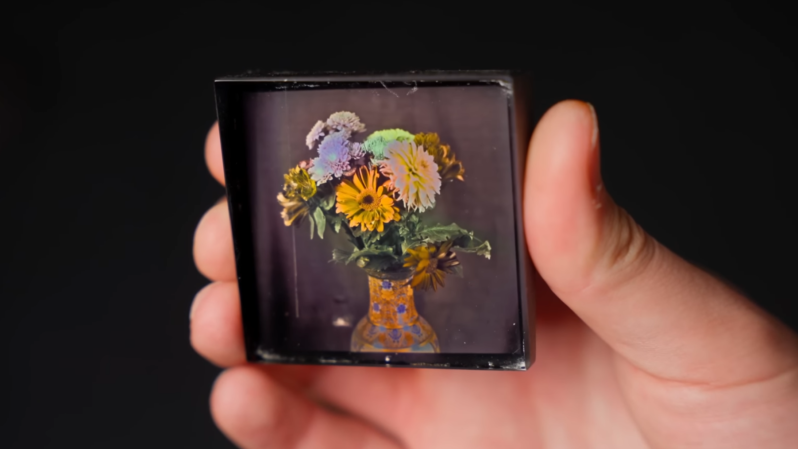
The principle behind Lippmann plates is essentially the same as that used in creating modern holograms. Both techniques rely on recording an interference pattern formed by two beams of light: in a hologram, the reference beam interferes with light scattered from an object; in a Lippmann plate, the same beam interferes with its own reflection. In both cases, the pattern is recorded as variations in the transparency or reflectivity of a photosensitive material. When illuminated, that pattern diffracts light to recreate the original wavefront. For Lippmann plates, the recorded wavefront is simply a single wavelength of light from the scene, resulting in a color that changes with angle—similar to a rainbow hologram. The basic idea of using photographic interference to encode spectral information lives on in many display technologies, including Bragg gratings and other volume diffractive optics.
Are there other historical methods of color photography that captured true spectra?
Lippmann plates are the most famous true-spectrum technique, but another early method, the autochrome, also avoided dyes by using a mosaic of microscopic potato-starch grains dyed red, green, and blue. Autochromes were easier to create and view, but they only approximated spectra by mixing the three primary grains—so they were not truly spectral. For the dedicated experimenter, modern hobbyists have recreated both Lippmann plates and autochromes. You can also make your own silver halide emulsion at home, though achieving the necessary grain size for Lippmann plates is extremely challenging. Thanks to historian and restorer Stephen Walters for reminding us of these fascinating lost arts.